


Discretionary Trusts: Tax Changes and Your Next Steps
Since the 2026 Federal Budget landed on 12 May, we have been fielding a wave of questions from clients about discretionary trusts – and rightly so. The government has announced that from 1 July 2028, trustees of discretionary trusts will be required to pay a minimum 30% tax on the trust’s taxable income before any distributions are made. This measure has been announced in the 2026-27 Federal Budget but has not yet been legislated. The details remain subject to consultation and may change before the legislation passes.
It is one of the most significant changes to trust taxation in decades, and it directly affects how families and small business owners use these structures. Here is what is actually changing, what it means in practice for a discretionary family trust, and what to do next.
Important: everything described in this article reflects the government’s announced policy as at the 2026-27 Federal Budget. This measure has not been legislated. Key aspects of the design – including the exact collection mechanism and how franking credits interact with the minimum tax – remain subject to formal stakeholder consultation. We will update this article once the legislation is tabled and passed. None of the content below should be treated as a basis for restructuring decisions until the law is confirmed.
What Actually Changed in the 2026 Budget for Discretionary Trusts?
From 1 July 2028, trustees of discretionary trusts will pay a minimum 30% tax on the trust’s taxable income, before any distributions are made. This is one of several significant tax measures in the 2026-27 Budget – for the full picture across CGT, negative gearing, superannuation, and small business, see our 2026 Federal Budget recap for business owners.
Until now, trusts have been one of the most powerful tools for managing tax across a family group. Distribute income to a spouse, a student kid, or a retired parent on a low marginal rate, and the family unit pays significantly less tax overall. That flexibility is part of what made discretionary trusts so widely used. According to the Treasury factsheet accompanying this Budget measure, around 350,000 active small businesses – less than 15 per cent of all active small businesses – operate through a discretionary trust structure.
That flexibility is now being heavily curtailed.
What Is a Discretionary Trust?
A discretionary trust (also called a family trust or discretionary family trust in everyday conversation) is a legal structure where a trustee holds and manages assets or income on behalf of a group of beneficiaries.
For a full breakdown of how discretionary trusts compare to unit trusts, hybrid trusts, and testamentary structures, see our guide to the types of trusts in Australia.
What makes it “discretionary” is the trustee’s power to decide each year how much income each beneficiary receives – and to whom nothing is distributed at all.
In Australia, discretionary trusts have been one of the most widely used structures for small business owners and families because of two core benefits: tax flexibility through income splitting across beneficiaries on lower marginal rates, and asset protection by keeping assets outside the personal estate of any individual.
Treasury estimates around 350,000 active small businesses in Australia currently operate through a discretionary trust. The 2026 Federal Budget targets this flexibility directly.
Discretionary Trust vs Family Trust – Is There a Difference?
In Australian tax and legal usage, the two terms are often used interchangeably – and for practical purposes, they usually refer to the same structure. A family trust is simply a discretionary trust where the beneficiaries are members of a family group. The trustee has the same discretionary powers either way.
The formal distinction matters in one specific context: a “family trust election” under the tax law gives the trust access to certain loss concessions, but it also restricts which beneficiaries can receive distributions without triggering family trust distribution tax. Most small business trusts have made this election – if yours has, it is worth confirming which beneficiaries fall inside the family group definition.
How the 30% Minimum Tax Actually Works
The mechanics matter here because the tax credit system produces very different outcomes depending on who your beneficiaries are. Understanding this is the difference between a minor adjustment and a major restructure.
Beneficiaries on 30% or Higher
If your beneficiaries are already on marginal tax rates of 30% or above, not much changes in practice. The non-refundable credit issued to the beneficiary cancels the trustee tax, and they pay what they would have paid anyway.
Beneficiaries on Rates Below 30%
If your beneficiaries include a student, a stay-at-home partner, or a retired parent on a low income, the excess credit above their marginal rate is lost. The 30% tax sticks.
Income splitting to low-rate beneficiaries – one of the primary reasons discretionary trusts have been widely used – becomes significantly less tax-effective under these proposed rules.
According to the Treasury factsheet, around half of discretionary trusts are not expected to be affected in any given year, particularly those where beneficiaries are already on marginal rates of 30% or above. The impact falls most heavily on trusts splitting income to beneficiaries on lower rates – students, retired parents, and stay-at-home partners.
Bucket Company Recipients
Under the proposed rules, corporate beneficiaries – including bucket companies – will not receive non-refundable credits for tax paid by the trustee. The Treasury factsheet confirms this is intentional: the measure is designed to ensure the minimum tax cannot be avoided by cycling income through a corporate beneficiary. If the trust pays 30% minimum tax and the company then pays tax again when distributing a dividend, the combined rate on that income increases significantly.
The exact effective rate will depend on the company’s circumstances and how dividends are eventually paid out. The bucket company distribution pathway as a tax minimisation strategy is heavily curtailed under these proposed rules – but the precise tax outcomes should be modelled for your specific situation before any decisions are made.
What This Means in Practice – Three Real Examples
The following scenarios are illustrative only. They are based on the proposed rules as announced in the Budget and are not tax advice. The specific tax outcomes in your situation depend on your trust structure, income levels, beneficiary marginal rates, and individual circumstances. All figures should be modelled by a qualified adviser using the confirmed legislative details once the law passes. Do not make restructuring decisions based on these examples alone.

Example 1 – A Professional Practice (Physiotherapy, $350K Profit)
Today, distributing income across the family (some to the operator, some to the spouse, a portion to the teenager, and the rest to a bucket company) produces a manageable total tax bill because of the spread across lower marginal rates.
Under the proposed rules from FY29, the same distribution pattern would attract the 30% trustee minimum tax on income before it reaches beneficiaries on lower rates, increasing the overall tax cost of that structure. The Treasury factsheet confirms that companies structured as base rate entities pay 25% corporate tax – potentially making a company structure more efficient for businesses retaining earnings, though individual outcomes vary.
The better long-term path for a business retaining and reinvesting earnings may be a company structure at 25%, but rather than dissolving the trust, it can continue to sit above the company shares, preserving asset protection without being the primary income vehicle. Whether that shift makes sense for your situation is exactly what a business structure review is designed to work through.
Example 2 – A Trade Business (Landscaping, $280K Profit)
This one is instructive because the answer depends entirely on whether family members are genuinely working in the business. If the spouse is legitimately managing bookkeeping and the kid is on the tools full time, paying them actual wages, rather than trust distributions, costs roughly the same in tax as the current structure and stays defensible. Wages aren’t caught by the minimum tax, distributions are. The trust stays in place, asset protection stays intact, and the tax position is clean.
Under the proposed rules, distributions to beneficiaries on rates below 30% would attract the minimum tax at the trustee level, increasing the overall tax cost relative to the current position. Paying genuine wages for genuine work is not caught by the minimum tax.
The Treasury factsheet specifically notes that “small businesses will be able to reduce the impact of the minimum tax by employing beneficiaries working in the business, rather than paying them a trust distribution.” If family members move to a wage arrangement, understanding the full tax picture including salary sacrificing and superannuation contributions becomes relevant to structuring their remuneration efficiently.
Example 3 – A Property Investor (Bucket Company Distribution, $120K)
Under today’s rules, that $120K hits the bucket company at the corporate rate and sits there efficiently. Under the new rules, the trustee pays 30% minimum tax first, the company receives the remainder with no franking credit, and then pays tax again when it eventually distributes a dividend to the shareholder.
Under the proposed rules, distributing trust income to a corporate beneficiary as a tax strategy becomes significantly less effective, because the corporate beneficiary cannot claim the credit for tax already paid by the trustee. Existing retained earnings inside bucket companies that have already been taxed at the corporate rate are a separate matter and are not directly affected by the trustee minimum tax. How those retained earnings should be managed going forward is a question for your specific structure and should be discussed with your adviser once the legislation is confirmed.
What If You Already Have a Company Under a Trust?
This is one of the most common questions we are hearing. The short answer: the impact is more limited, but it is not zero.
If the trust acts purely as a passive holding shell over company shares and does not earn or distribute significant taxable income of its own, the day-to-day impact is relatively contained. The company continues to pay tax at the corporate rate as it always has.
The issue arises when the trust earns income of its own – rent, investment returns, distributions from other entities – and then passes that down. In those situations, the 30% minimum tax still applies at the trust level before anything moves. If the trust then distributes to low-rate beneficiaries or another bucket company, the same problems apply.
If you are in this position, the structure probably does not need an urgent overhaul. It may need a review once legislation passes and the exact mechanics are confirmed. The key question is whether the trust is genuinely passive, or whether it is quietly doing income work that will now cost more than it used to.
ATO Focus on Discretionary Trusts – What Has Increased Scrutiny Looked Like?
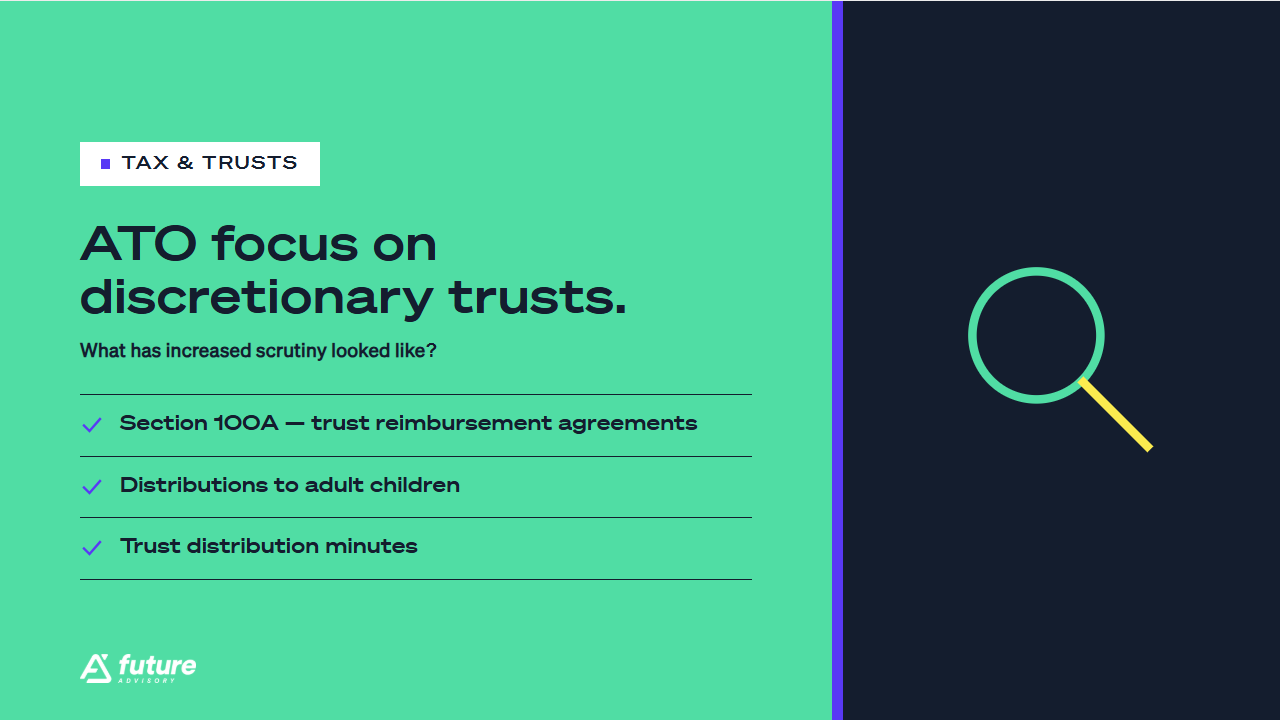
The 2026 budget minimum tax is not the ATO’s first move against discretionary trust structures. The ATO has been increasing scrutiny on discretionary family trusts for several years, with particular focus on three areas.
Section 100A – Trust Reimbursement Agreements
Section 100A is an anti-avoidance provision the ATO has used aggressively to challenge situations where a beneficiary is made “presently entitled” to trust income but does not actually receive and enjoy it. If income is distributed on paper to a low-rate beneficiary but the economic benefit flows to someone else (for example, a parent), the ATO can recharacterise the arrangement and tax the income at the top marginal rate. The ATO’s 2022 guidance materially expanded what it considers to be a reimbursement agreement.
Distribution to Adult Children
The ATO has specifically flagged distributions to adult children living at home as an area of compliance focus. If an adult child is a beneficiary but their distribution is effectively used for family household expenses, the ATO may argue a Section 100A arrangement exists.
Trust Distribution Minutes
Resolutions must be made before 30 June each year. The ATO has denied deductions and challenged distributions where trust minutes were prepared after the financial year end, or where the distribution resolution was inconsistent with the trust deed. Record-keeping discipline is not optional. If you have already received an ATO compliance notice or penalty in relation to trust distributions, our guide to ATO compliance and penalty remissions explains the process for requesting a reduction.
Combined with the 2026 Budget minimum tax proposals, the ATO’s compliance focus on discretionary trusts has intensified across multiple fronts. Trustees should ensure distribution resolutions, beneficiary entitlements, and trust minutes are in order regardless of how the minimum tax legislation progresses.
The Advice You Have Probably Already Read – and Why It Is Incomplete
You’ll hear two things a lot over the next 18 months: “just incorporate” and “move it to a fixed trust.” Both of these solve the tax problem. Both of them can compromise everything else the trust was doing.
Why “Just Incorporate” Is Not the Full Answer
A discretionary trust was never only a tax vehicle. It was a wealth protection structure. Assets held in a trust sit outside your personal estate – harder for creditors, ex-partners, and litigation to reach.
Transferring those assets to a company means your shares become your personal property: visible, attachable, and divisible in a divorce. Every share movement is a CGT event. Rollover relief helps, but it does not eliminate every cost. If your trust holds property including a family home, understanding how the main residence CGT exemption works in the context of a restructure is important before you move anything.
Why Switching to a Fixed Trust Is Not Equivalent
A fixed trust removes the minimum tax problem because entitlements are predetermined – but it also removes every reason you used a discretionary trust. You can no longer distribute more to a family member who has lost their job or less to one who has started earning well. Converting from a discretionary to a fixed trust can trigger state stamp duty events that the federal rollover does not cover. Succession becomes harder. Loss flexibility goes. A fixed trust is not a discretionary trust with the tax problem removed – it is a structurally different instrument.
Some Situations Are Worse Than They Look (eek!)
There are two scenarios that aren’t getting enough attention yet.
Losses Get Stranded Across Multiple Trusts
One area that warrants technical review once the legislation is tabled is how the proposed minimum tax interacts with multi-trust family group structures where losses exist in one entity and income in another. The Treasury factsheet does not specifically address this scenario, and the mechanics will depend on how the legislation is drafted. This is an area where specialist tax advice is essential before drawing conclusions. If you operate across multiple trusts, flag this with your adviser when the legislation is available for review.
Trust-to-Company Distributions Create Double Taxation
Under the proposed rules, the trust pays 30% minimum tax on taxable income. A corporate beneficiary (such as a bucket company) that receives a distribution cannot claim a credit for the trustee’s minimum tax.
When the company subsequently distributes a dividend to its shareholders, company tax will have applied at the corporate rate (25% for base rate entities). The trust-level tax is not available to offset the company-level tax.
The Treasury factsheet confirms this outcome is by design. The precise combined rate depends on the company’s tax rate, dividend treatment, and individual shareholder circumstances.
When the dividend is paid out from the company only the company tax will be available to reduce the tax of the recipient and the trust tax is forgone.
What Not to Do Before the Legislation Passes
- Don’t dissolve the trust entirely. Even if it’s no longer working as a distribution vehicle, the asset protection layer is still doing its job. Keep the structure, change the function
- Do not restructure before the legislation passes and before 30 June 2027. The rollover window is announced to open 1 July 2027 for a period of three years, according to the Treasury factsheet. However, the exact terms and eligibility conditions remain subject to consultation. Moving before the legislation is confirmed risks triggering CGT on a transfer that may not have been necessary, or that would have been covered by rollover relief under the final rules. Move before that and you trigger CGT on the transfer. Plan once the legislation has been passed and execute when it makes sense to, not because you’ve panicked early. We have time!
- Don’t replace your bucket company with a new bucket company. The strategy isn’t broken for existing retained earnings – wind it down deliberately rather than replacing it.
Who Needs to Act – and Who Does Not
According to the Treasury factsheet, Australia has over one million trusts in total, of which around 840,000 are discretionary trusts. Around half of discretionary trusts are not expected to be affected in any given year – primarily those where all beneficiaries are already on marginal rates of 30% or above.
Most Affected
- Discretionary trusts splitting income to low-rate beneficiaries (students, retired parents, stay-at-home partners)
- Trusts distributing to bucket companies
- Trusts distributing franked dividends to retirees or low-income beneficiaries
- Trading businesses and investment properties operating through a discretionary family trust in Australia
Largely Unaffected
- Trusts where all beneficiaries are already on marginal rates of 30% or above
- Primary production trusts
- Existing testamentary trusts
- Special disability trusts
- Charitable trusts
- Widely held trusts (most managed investment trusts)
- SMSFs
Five Questions to Work Through Before You Change Anything
Before you restructure, there are five things worth working through.
- Is the trust running an active business, or holding assets? The answer changes everything.
- Who are the actual beneficiaries and what are their real marginal rates?
- What was the trust originally set up to protect against? If estate planning and succession were part of the original purpose, our guide to deceased estates and inherited assets covers how assets passing through a trust interact with estate obligations.
- Does family genuinely work in the business? Wages aren’t caught by the minimum tax, distributions are.
- What does the state duty position look like? The federal rollover doesn’t cover stamp duty, and state law applies.
This is the most significant change to trust taxation in decades. The government has announced three years of rollover relief from 1 July 2027 to support businesses and individuals who choose to restructure out of discretionary trusts. The Treasury factsheet states this relief will cover income tax consequences including capital gains tax for those who choose to move to a company or fixed trust structure. Whether restructuring is the right decision for your situation depends on your individual circumstances.
But that doesn’t mean everyone should. It means everyone with a trust should understand exactly what their structure is doing, why it was set up, and what the real numbers look like under the new rules, before making any decisions.
What to Do Now
The 2026 Federal Budget has signalled the government’s intent on discretionary trusts in Australia clearly. Whether that intent survives the legislative process unchanged remains to be seen – but waiting until legislation passes to start the conversation is too late for some structures.
Here is a simple prioritisation:
- Begin a planning conversation now if: you are regularly distributing to low-rate beneficiaries or to a bucket company. The purpose of that conversation is to understand your current position and model the impact under the proposed rules – not to take action before the legislation is confirmed.
- Monitor and plan ahead of the rollover window (announced as opening 1 July 2027) if: you are considering restructuring into a company or fixed trust. The rollover terms are subject to consultation and may change. Do not execute a restructure before the legislation passes.
- Monitor and revisit once legislation passes if: your trust is largely passive or all beneficiaries are on rates above 30%.
- No action needed now if: you are a primary production trust, testamentary trust, SMSF, special disability trust, charitable trust, or deceased estate. These are excluded from the proposed minimum tax under the Treasury factsheet.
Future Advisory works with small business owners and families across Melbourne and Australia on business structure decisions, trust setup and review, and tax planning. Our accounting and tax services include discretionary trust reviews, restructuring advice, and CGT planning. We will update this article and our clients directly once the legislation passes and we have a confirmed action plan.